How It Looks When the Blind See

When people ask me what Mercy Ships does, I usually have to take a deep breath and gather myself, so I don’t startle them.

The official answer is: Mercy Ships operates the largest, civilian hospital ship in the world. It’s a floating, western, surgical ward doing orthopedics, fistula repair, cleft palate and plastic surgeries on the poorest of the world’s poor – primarily in Africa. We follow the 2,000 year model of Jesus – the blind see and the lame walk.

I tell them that, then I tell the eye stories.
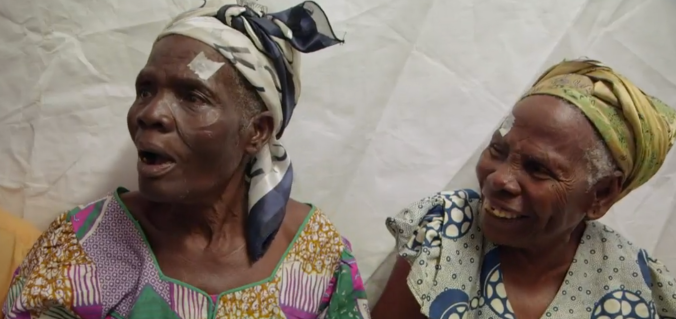
Mercy ShipsClick here to watch this one minute video, as the bandages are removed from these women.

The women were featured on a Swedish television show last week. It was a cooking show, wherein the host goes interesting places and cooks things. A few months ago, she came to the Africa Mercy, while it was docked in Pointe Noire, Congo. If you have time and speak Swedish you can watch the whole show. Evidently, one-third of the Swedish population did.

During our ten-month field service in the Republic of Congo, our volunteer eye surgeons performed nearly 1,000 cataract surgeries. In other words, 1,000 people who were blind, can now see – including these two. In addition, Mercy Ships staff performed another 1,900 cataract procedures and mentored eight local ophthalmologists and nurses.

You see, if you develop cataracts in the United States you can make an appointment for a 15 minute surgery and regain your sight in a week. If you develop cataracts in Africa – a malady particularly common in the equatorial nations – and you’re poor, you just go blind. That means you cannot work, which usually means you and your family cannot eat.

Following Jesus’ example, Mercy Ships is restoring people – one by one. Restoring their vision, their bodies, their dignity and very often their place in the community.

You can help us you know. To get involved click here.

*The views expressed herein are my own and not that of Mercy Ships.

Why We’re Better Together

Welcome NiceLaughter bubbling out of a room full of women is my favorite sound. Especially when, two hours before, they didn’t know each other.

At Love Dinner #10 last night, one woman made a comment about God opening doors for us. But lately, she said, hers feel like a trap door to a slide. Everyone died laughing. Each of those gorgeous women sitting in my living room, sipping coffee, or cross-legged on the floor poaching blackberries from the fruit salad, know that feeling. Articulating it makes us allies.

Everybody brought something hard to the table last night and then we prayed. We’ve learned that fueling up together readies us to get back out in the world and do what Jesus said: Love God and love each other. We’ve also learned that the second command doesn’t work right without the first.

Luckily, once you get to know Jesus, it’s easy to love Him.

When Jesus is in your midst, it’s like listening to the best piece of music you’ve ever heard, while drinking a glass of wine and watching the sunset turn the mountains pink.

All that goodness, all that grandeur is at once overwhelming and still somehow incomplete. That’s why we jump up and run into the house looking for someone to share it with. Then when we stand shoulder to shoulder on the deck, in a moment of unscripted silence, just gazing at it, absorbing it together, that’s when it’s finally perfect.

That’s the magic of Jesus + us, and the purpose of Love Dinner. To be so overcome by the dazzling presence of Jesus, that we run brimming and sparkling, back out into our broken, sad world saying “Come quick. You have to see this.”


Just Fine and the Drowning Girl

Love DinnerYesterday, I had a three-minute conversation with a friend in which she wound up in tears. It was just an average conversation, on an average Tuesday, until I looked her in the face and said something that was probably a little heavy for the office.

It’s scary to step around a person who says they are  “just fine,” to reach for the other one struggling beneath the surface.

But it’s important because Jesus did all the time. He did it for blind men, prostitutes, lepers, deaf mutes, kids, outcasts and soldiers. He said to them, “I see you in there, I see where it hurts, be brave and bring it to me.”

People, we need less noise and more love. To look into, rather than just at, each other, which is sometimes a messy and expensive proposition. Jesus said, you will know my followers by their love for one another –  not their politics, their words, their church or their jewelry. Just their love. That’s it.

I’m telling you this, because I’ve been drowning for the past few weeks, while telling people it’s fine. It’s not fine. When my fall trip to the ship got postponed until spring, I sank. Traveling with Mercy Shippers, encouraging them to grab hands with Jesus and run wherever he leads, is something I was born to do.

However, a few wise folk have suggested that by this delay, God has cleared my decks, so I can refocus on the other thing I was born to do – to write. What a privilege to have two equally interesting but demanding passions. Certainly, getting here was a process and that’s the subject of the book.

So while I chastise myself for drowning, Jesus doesn’t see it that way. He looks right past my “Just Fine,” reaches for me and says, “I see you in there, I see where it hurts, be brave and bring it to me.”

He does it for us, then we do it for each other, and that’s how this job gets done.

Photo Credit: Sonny Lazzeri

Photo Credit: Sonny Lazzeri

Recently, one of my favorite writers Shauna Niequist announced she’d begun writing her next book. I love Shauna and her kitchen table because as her lively tribe gathers round, it’s apparent how sterile a life of independence can be; how tragedy, apology and pain are necessary to the whole plot. In time, everybody’s lives get tangled together like grapevines, heavy with fruit and flowers. Then Shauna writes about it.

Does this sound familiar? That’s Love Dinner and why it’s back – this Saturday. We need each other more than we care to admit, and sometimes we just need to collapse at each others’ tables and quit drowning for a minute, letting people who love us, pull us out of the water.

I don’t know why it’s taken me so long to figure out the pattern here, but I finally see it. For the last year, I’ve allowed writing books and going to Africa to be mutually exclusive activities, but they’re not. No matter where I am – on a ship, in a garden, at the table with friends – my life is in the people, and the object is always the same:

Point them to who they are in Jesus, watch what happens and write it down.

That, to me, is a story worth reading.