An Election Season Practice.

photo courtesy of Tulane PR

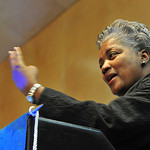
Vice Chairwoman of the Democratic National Committee, Donna Brazile, recently said something interesting about Karl Rove.

I can feel you tensing up…Oh no Erin what are you about to say? Will I have to quit reading your blog?

It’s ok. Relax.

In a column in Oprah Magazine Brazile said this:

When I feel myself getting steamed up over an issue, it really does help to remember the rich humanity of my so-called opponents – even one as formidable as former Bush adviser Karl Rove. Competing against him was blood sport – and yet he and I have a great rapport. We discovered early on that we share a love of history. Karl doesn’t just know dates and facts; he can tell you what people were eating, drinking and thinking in 1896….He’s proof that it’s possible to disagree with someone on just about everything and still respect them.

Brazile reminds herself to see Rove, her opponent, as a human with whom she might have something in common. She might not always feel like doing that, which is why it’s a practice.

Is it really ok to hate people with different opinions, as the current religious and political climate in America would suggest? Are we supposed to isolate ourselves from people with whom we disagree? That’s certainly easier, but does it make anybody safer or more righteous? Timothy Keller author and founder of the fabulous Redeemer Presbyterian Church in Manhattan thinks not.

His New York Times Bestseller The Reason for God is a capacious and thoughtful treatment of the typical objections to Christian faith like, “a good God wouldn’t allow suffering” and “why is the church responsible for so much injustice.” In it, he says, the more we separate ourselves from those unlike us, the easier it is to see them as other and vilify them, which makes violence toward them seem defensible.
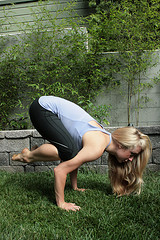
This is not me in bakasana. Photo by DL Chang.

I’m guilty, especially during elections. So I’m practicing, just like I practice bakasana on my yoga mat. Both are hard.

I told someone yesterday, I am not putting a campaign sticker on my truck this year, not because I’m tempted to bicker, but because I hold a minority opinion in my area; and people seem so angry, I’m afraid of what it could mean for my vehicle. Maybe I’m overreacting, but last election a friend was angrily confronted in a parking lot for this exact thing. There was no debate or exchange of ideas, a stranger just walked up and called him an idiot.

Sorry, but Jesus would not have that. Check Matthew 5:22 if you’re unsure. This is what he wants instead:

You can develop a healthy, robust community that lives right with God and enjoys its results only if you do the hard work of getting along with each other, treating each other with dignity and honor. James 3:18 The Message.

That’s not a platitude or at least it shouldn’t be. It’s a discipline and election season is a great time to practice, no matter what side we’re on.

Two Paths

Last week on a trip to North Carolina, I sat next to babies on crowded, back-to-back flights. The experience has me considering Jesus’ teaching on the broad and narrow paths.

DFW to Atlanta – Struggling to board the plane at the last minute was a family of four. Mom’s hair escaped her pony tail as she hauled two girls, a blanket, three carry-on bags and a sampling of airport food to her seat. The girls, maybe two and four, were followed by a man with one small bag and a flat-brimmed ball cap turned sideways; a man who later loudly clarified that he was not husband but Baby Daddy.

As the plane took off, Mom ripped the foil wrapper off a plastic tub of orange cheese, dipped a giant, soft pretzel in it and fed it to the baby. When the baby got thirsty, Mom poured some Mountain Dew into her sippy cup.

Baby Daddy was sitting a few rows up and after take-off, he came back and helpfully took the baby up front. He returned 30 minutes later, to the poorly ventilated aft cabin, wearing chunky, pink cheese puke on his expensive jeans and holding the baby at arm’s length.

“I don’t know what to do about this,” he said to the child’s mother, kicking off 90-minutes of near-total chaos in the back of the plane.

“Enter through the narrow gate. For wide is the gate and broad is the road that leads to destruction, and many enter through it,” Jesus said in Matthew 7:13.

He wasn’t talking about feeding your kid cheesy pretzels and Mountain Dew on an airplane, but that is clearly a broad path choice. He was urging us to believe he was who he said he was, thereby giving us the tools of the narrow gate – peace, love, joy, patience, goodness, kindness, gentleness, humility, faithfulness and self-control.

I wanted to school that woman on the plane, but isn’t that a broad path choice too?

In her New York Times bestseller One Thousand Gifts, author Ann Voskamp writes of using God-lenses to view the world as a gift, rather than seeing only its terrible messes. Because of Voskamp and the narrow gate, I donned God-lenses on the plane, and wound up holding that barfy little girl while her Mom dealt with a major secondary crisis.

Before I read the Bible, it wouldn’t have occurred to me to do that. In fact, I would have silently gloated as that woman suffered the consequences of her choices. What if Jesus made me suffer the consequences of my choices? Oh My God…..

One of the amazing surprises to come from studying The Bible is how often I wind up on the narrow path without really trying. Sometimes I only notice it in hindsight, when I’m walking away thinking “Wow, that was nice of me, weird.”

When I don’t study my Bible, I focus on my plan and charge down the broad path with everyone else, where I behave with impatience, pride and indifference. There, I usually wind up puking on somebody.

The world thinks the narrow path is about privation. It’s not. Jesus said he came so we might enjoy life and have it in abundance. The broad and narrow paths are a simple reminder about causation; and unruliness is costly. So if our actions ripple, as we all know they do, which path produces better ripples?

Broad or narrow?

On Scorpions and Worry

I know better than to worry, but that rarely keeps me from doing it. I keep catching myself ten minutes into a preemptive, imaginary argument wherein I defend myself against something that shows no sign of actually happening.

Before I began my Bible-reading experiment, two years ago, I spent most days in that jungle. Now, at least I notice it and start beating back the vines before they take over my fields.

Years ago, I was in Indonesia, sitting on the porch of a beach hut, next to a stack of firewood. My friend Allison walked onto the porch to put her shoes on. Resting her hand on the woodpile for balance, she erupted into a howling explosion of screams. Another friend came running out and gleaned enough information to shine a flashlight on the woodpile.

Allison had laid her hand on a scorpion and in return it laid hands on her.

I narrowly missed the same experience this week at my home in Texas. Standing at the fridge, filling a glass of water, I stood with my big toe resting on a scorpion. Oddly, it did not sting me, but instead provided a clear object lesson, directly from Jesus, on the topic of worry.

All week I have worried that the book I’ve spent two years writing is not nearly __________ enough – you can fill in any number of modifiers. I’ve also nursed the concern that the still, small voice upon which I’ve relied to write it, has softened so much as to become inaudible.

Here’s how I know God thinks I shouldn’t sweat that:

On Sunday, Isaiah 54 fell out of my bible, literally the page came loose and fluttered to the floor. It’s not a famous passage like John 3:16, but it’s famous to me, so it gave me pause. Verse 1 says, “Sing o barren one, you who did not bear: break forth into singing and cry aloud you who did not travail with child! For the (spiritual) children of the desolate one will be more than the children of the married wife, says the Lord”

Isaiah was talking about the redemption of Zion, but it speaks to me because I have tried to have children and cannot. I turn 40 in a week and it seems that horse has left the barn. So either I have just broken the spine on my bible there or the God I think I can’t hear anymore is telling me to quit worrying about legacy and sing.

Secondly, Joseph Prince a Singaporean pastor I like, is the third person I’ve heard this week discussing rest and freedom from worry; and coming to know God like I have, has made me skeptical of coincidence.

Considering all that while filling my water glass, I looked down and saw that little lobster-shaped insect under my toe. I screamed and jumped backward and he skittered under the fridge.

Then this scripture whistled through my mind like a bottle rocket: Behold! I (Jesus) give unto you power to tread on serpents and scorpions, and (physical and mental strength and ability) over all the power of the enemy; and nothing shall by any means hurt you. Luke 10:19

Whoa, do I have literal power and authority to trample on scorpions? Evidently, but that’s not the point and I don’t intend to test it. The point is, after several tries, the light came on. Jesus said, “fret not” “fear not” “don’t worry” “stop worrying” “trust me, don’t be afraid” because he knew that faith and fear are mutually exclusive and for humans, fear is the default position. Before I read the Bible, I didn’t know I had a choice. I didn’t know that the Bible is an arsenal, ready to help me do battle with fear and anxiety, but I have to enter it every day and gather what I need for dealing with a scary, messed-up world.

So if Jesus gave me power over the enemy and nothing will in any way harm me, why am I worrying about anything; much less the outcome of a book I wrote about the power of God. Now, each time I catch myself worrying, I recall standing un-stung on a scorpion and I say, “so what am I worried about?”

Incidentally, the scorpion was a different story. Despite my appeals for clemency on account of his good behavior, he was dispatched by my husband Sam, a man with a far less spiritual view of poisonous insects in the kitchen.